Showing posts with label Wikipedia. Show all posts

Friday, August 27, 2010

Wiki Rummage #6: Octopuses

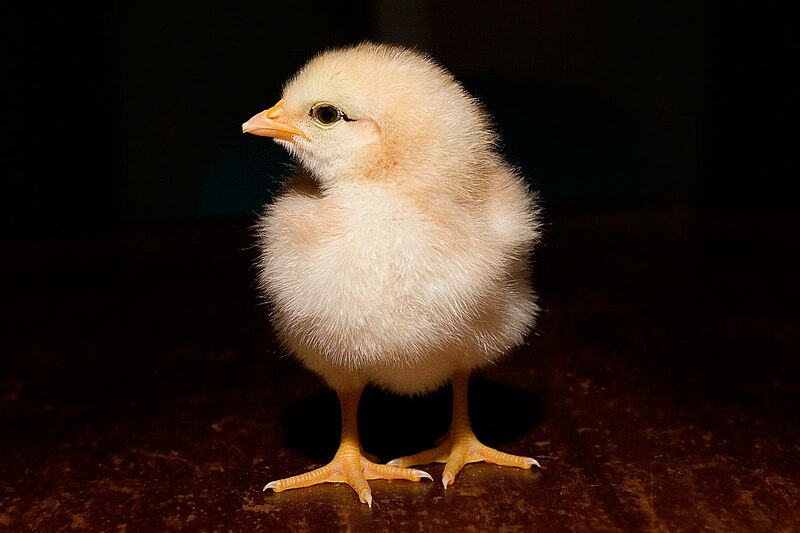
Wikipedia's biggest pull factor for me is that the large majority of articles are presented in a succinct and relevant way. Complex topics are often simplified for the layperson, but simple topics usually contain comprehensive information that your average joe wouldn't know. A good example of these kinds of articles are the ones on ants, chickens and today's article, on the humble octopus.

Octo means eight, and -pus comes from the word pous, meaning foot. This gives a whole new dimension to the expression 'pussy footing', which actually, now that I think about it, is probably a feline reference. The Oxford English Dictionary lists the plural form as octopuses, which is the right way to say it. Despite what you may have been led to believe, the word 'octopi' is a hypercorrection, and less accurate. That's because 'octopus' is not a purely Latin word, it's a Latinisation of the Greek third-declension masculine. If the word were truly Latin, it would be octopes, with the plural form of octopedes.

If you want to be cool, you can use the alternative plural which is octopodes.
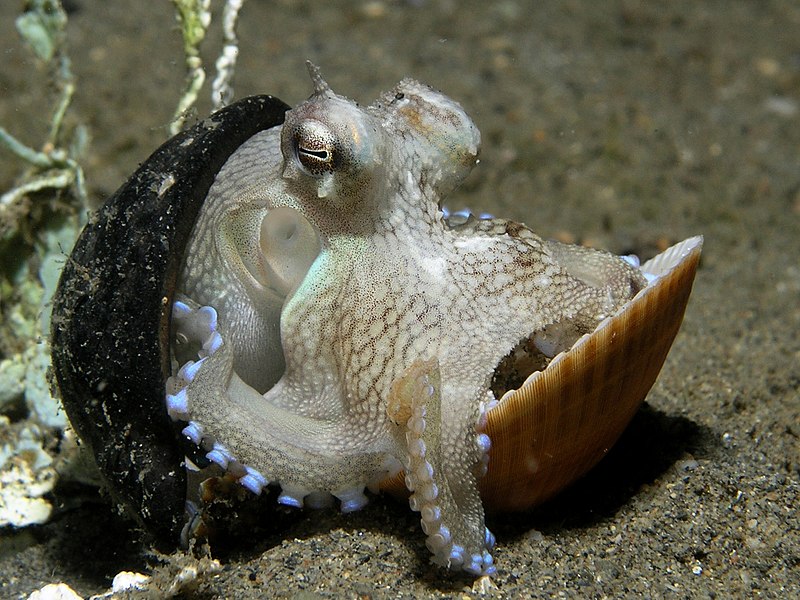
Our octopode friends are cephalopod molluscs, evolutionary descendants of shellfish and cousins of snails. I believe the technical term is 'squishy'.
As masters of disguise, they can mimic highly complex backgrounds with their skin, even forming small knobbly protrusions to get the texture right. They also employ jet propulsion to escape and can expel ink to confuse predators, including hungry Korean hae-nyo.
In fact, no organism is more worthy of the non-existent Animal Magician of the Year Award. To compensate for this minor injustice, Lee's Korea Blog has decided to hereby invent and dedicate this inaugural award to octopuses everywhere.

Mental round of applause please.

See, this is what I'm talking about. The video above is showing an octopus disguising itself as a coconut bobbing along the ocean floor. The only tell-tale sign is that you can see two little pedes, which are sneakily providing locomotion.
We will just ignore, for the time being, that an intelligent predator may realise that most coconuts actually float. Full points for creativity.

Octopuses are intelligent animals, described by divers as having distinct personalities. Some are aggressive, while others can be timid, curious and even friendly. In the UK they are legally defined as 'honorary vertebrates', subject to animal rights protection. They have three hearts and blue blood, because they use copper-based hemocyanin to carry oxygen rather than the hemoglobin common to mammals.
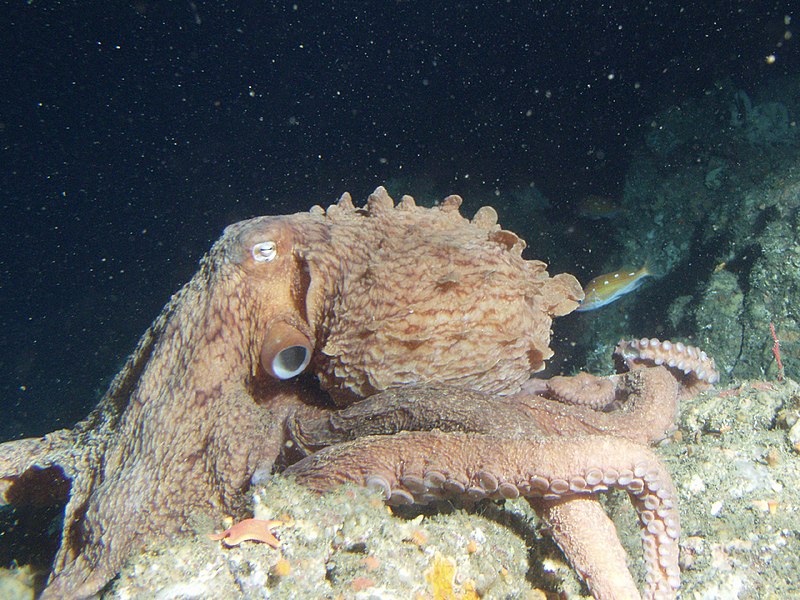
Apart from being munched upon, a major cause of death for octopuses is reproduction. Males will die within a few months of mating and females commit programmed suicide if they are not predated upon. After taking care of their eggs, girl octopuses can secrete endocrines from their dual optic glands which knocks them out like cyanide.
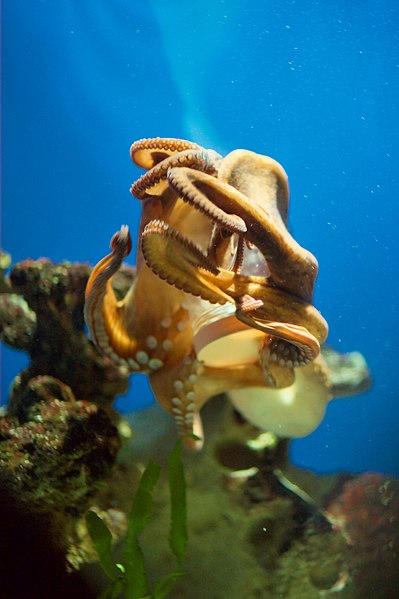
Because octopus arms are highly complex, their brains do not have the processing capacity to form a mental picture of what their arms are doing overall. Instead their brains just issue basic commands, and the nerve cords in the arms figure out what to do. There are no feedback systems in place to let the brain know what an arm just did, so the octopus learns what happened by watching the outcome.

Octopuses have also been seen playing with bottles in captivity and have a reputation for escaping from aquariums without a fixed lid. A story I heard when I was young was that an elementary school classroom once had a tank with live crabs in it. Across the room was a separate tank with a pet octopus. After a while, the crabs started disappearing and so eventually the teachers installed a CCTV camera to figure out who was taking them. Lo and behold, the tape revealed that the crafty octopus was escaping its tank at night, walking across the classroom, feasting on the crabs and then walking back to its own tank. They have even been known to board fishing boats and open holds containing a fisherman's catch. 

Which is technically not piracy, but maritime theft, I believe.
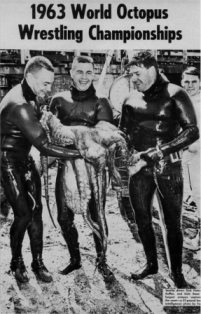
And finally, octopus wrestling involves a diver, preferably without breathing apparata, wrestling with an octopus and bringing it to the surface. It was pretty popular in the 1960s.

Here's a quote from the article:
"All this while O'Rourke was becoming perhaps the world's greatest authority on the thought processes and the personality of the octopus. He knew how to outmaneuver them, to outflank them, and to outthink them. He knew full well, many years ago, what today's octopus wrestlers are just beginning to learn--that it is impossible for a man with two arms to apply a Full Nelson on an octopus; he knew full well the futility of trying for a crotch hold on an opponent with eight crotches."
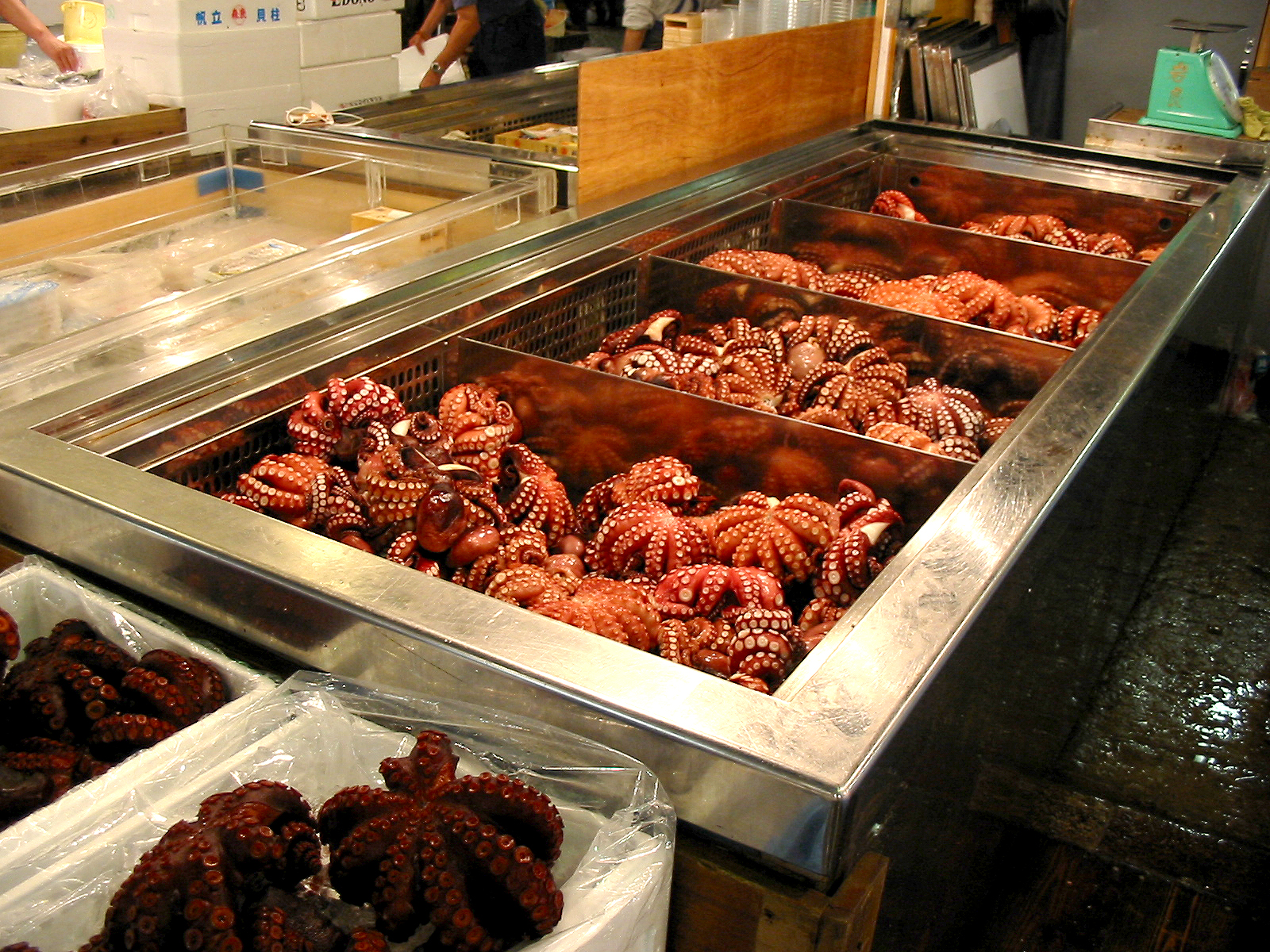
Man and octopus are probably destined to misunderstand each other for an eternity, due to their alien-like appearance and competing culinary interests. We also tend to limit their romanticism to Cthulu mythology and odd fetishes.

But the next time you dine on a takoyaki or jjukkumi, ponder the revelation that you'd probably not be so handsome either, if your body plan included eight arms and a beak.

Monday, August 09, 2010

Wiki Rummage #5: Biological Dispersal

Biological dispersal refers to a species movement away from an existing population or the parent organism.  For example, if an apple tree sprouted a sapling, the biological dispersal of the sapling would be how far away it is from the parent tree. Your individual dispersal range would be the distances you have traveled from your birth place.

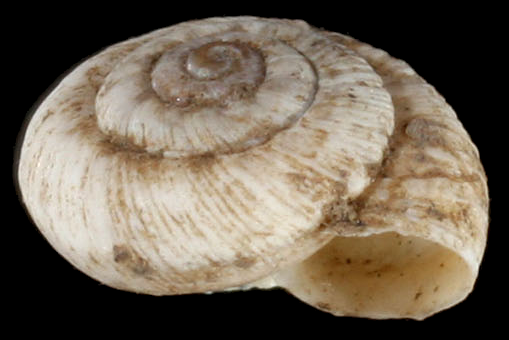
Xerocrassa geyeri is a species of land snail in central Europe with a biological dispersal capacity of about 3 metres during its entire lifetime. High dispersal capacities simply represent the ability that a species has to colonize distant lands. For humans in a post-colonial and globalising world, this becomes less of an issue.

Most plants have a limited dispersal capacity because they are unable to move. A lot of them get around this by using the wind, water or animals to spread seeds to new territories. Banana trees advertise their fruit with colours and reward animals who eat them at the right time with a pleasant flavour representing energy in the form of carbohydrates. The banana seeds pass through a monkey undamaged, and come out the other end preferably a measurable distance away from the parent tree. Not only that, but the young seeds are deposited in their favourite food, monkey poo. So in effect, monkeys are seen by plants as a handy means to get their offspring from A to B. But of course, smarter monkeys have learned to circumvent the system with agriculture and sewerage systems.

Another interesting concept that arises from this is the idea of stationery life. Plants have been remarkably successful at living stationery lives, while all land animals have had to develop motility to find food. If we could eat sunlight, chances are that we wouldn't need legs, which get us into trouble by running us into trees and falling off cliffs etc.

Sponges and corals in the ocean are some of the only examples of non-motile animals. This is possible because seawater is a physically supportive medium that can hold food and disperse it in three dimensions. Air doesn't have the physical ability to hold large amounts of food, such as krill or plankton. If it did, then there would probably be more stationery animal life on land. 

Plankton in particular enjoys a magnified dispersal range due to the vast ocean currents that move it across the world. But the same mechanism by which tiny zooplankton achieve biological dispersal is also the one that often leads to their doom, in the form of a hungry coral's mouth. Plankton is a Greek word, meaning 'wanderer' or drifter. If you're currently traveling the world like this guy is, you could consider yourself to be a plankton.

Human biological dispersal would cover parts of the lithosphere, and to the orbit of the moon. But how do you increase your own biological dispersal? Well, by simply traveling further from your place of birth. Because I was born somewhere around here, I've limited my individual dispersal range by moving back to Korea. Which is not very relevant from an evolutionary perspective, due to the ease at which we can travel these days. 

Dormancy is regarded as dispersal in time, although sleeping and dormancy are not the same. To achieve true dispersal in time, you'd have to freeze yourself at 77.15 degrees Kelvin and resuscitate yourself at the appropriate time. 

Or you could pay a cryonics company US$150,000 and save yourself the hassle.

Monday, June 14, 2010

Wiki Rummage #4: Benefits of Meditation

During the week, I teach company workers at Lundbeck Korea, a Danish pharmaceutical company based at the World Trade Center building in COEX. There are five students in total, and we have 1 on 1 conversational classes focusing on critical thinking and discussion. They're quite enjoyable lessons, and a good way to discuss interesting topics with intelligent 'students' (they're all married and most of them have children, so I feel more like the student). Some of the topics I get from various news sources, and others from Wikipedia.

IMG_2143
We're on the 29th floor of the building above, and our lessons take place in a quiet little room with a conspicuous lack of indoor plants. Most weeks I'm fairly busy, so before the classes start, I take an article with me on the subway, and read it while eating dinner in the COEX foodcourt below. A recent one I taught was on meditation, which I thought was helpful enough to share with you all here.

Meditation has always been something I didn't pay much attention to in the past, but I recently read about a study on the benefits of meditation from a scientific point of view. The American Heart Association claims that regular meditation reduces the risk of heart attacks and stroke, significantly lowers blood pressure and reduces psychological stress. I started to read more on the topic and found some high-profile studies linking meditation to increased brain health and stronger immune systems.

When I asked myself the question, "Why not try meditation?", my best responses were because I didn't have time and because I didn't want to become a hippy. Now dear readers, a modestly wiser and somewhat more mature author of this blog will attempt to dispel some of your possibly ill-conceived notions about this ancient practice.

First of all, meditation doesn't have to be religious or spiritual at all. You can think of it simply as a way to relax the mind and unwind from a stressful day. Secondly, there is no set way to do it. There are many styles, but you can just do whatever works for you.

The only two things you need are time (15 minutes is good), and an environment without distractions. In today's busy lifestyles, these may not be so easy to come by, but at least they're free of charge. Heather and I started meditating after dinner on weekends, which seems to work well.

Sit in a relaxed position, on the floor or on a seat. You can sit however you want, but lying down isn't advised because you're likely to fall asleep. Sleeping is not meditating, because your mind is unfocused and you lose control of your breathing. And the most important part of meditation is to control your breathing. Close your eyes and focus on keeping your breathing slow, calm and much deeper than normal. You can put your hands on your knees if you like.
Try to clear your mind of stressful thoughts, and keep things simple. Other thoughts will creep into your mind, and don't try to resist them. My strategy is to let them come and go, without paying them too much attention. For example, I might be drifting into a peaceful frame of mind, but then I start to remember some events of the day. I just let these thoughts come and go without giving them too much value. You get better at this with practice (it took a few sessions before I was even able to meditate convincingly), and eventually your distracting thoughts just flow through your mind like sand through your fingers. If you hear noises from around you, just let them come and go.

After fifteen minutes, or when your legs get cramped, just slowly bring your mind back to the present and have a stretch. If you were keeping your breathing deep and regular for the whole time, you'll notice that you're in a considerably more contemplative mood and feeling pretty good in general.

Meditation helps you realise that everything is experienced as a state of mind, and this can improve your daily life. When irritating events happen during the day, you start to view them as a detached observer, instead of getting frustrated. As one article put it "You learn to understand the monkey tricks of your mind."
Practicing the meditative state of mind can really help you to take a step back and look at the deeper picture. A large proportion of the frustrating problems that we come across in our daily lives are not worth agonising over in the long run.

Most importantly, there is no defined way of doing meditation. It can be done in busy elevators or crowded subways, with your eyes open or closed. Just focus on your breathing and let go of the stressful thoughts in your mind. Try it for yourself and see if you notice a difference.

May your meditation bring you inner peace and harmony...

Friday, May 28, 2010

Wiki Rummage #3: Chickens

We're living in a culture of consumerism as a direct result of the industrial revolution. Not all of us are lucky enough to enjoy the luxuries of the developed world, but if you're reading this blog, chances are that you are pretty well off. 

After enjoying a few pieces of fried chicken the other day, it struck me that we grossly underappreciate our feathered friends. I recently came across the article on chickens while link surfing through the cloisters of Wikipedia. As often happens when I partake in such activities, I was pleasantly surprised by the amount of novel information I learned. And as Margaret Fuller once said, "If you have knowledge, let others light their candles in it."

Right now, living, breathing and clucking on 'our pale blue dot in the cosmos' are 24 billion chickens. Most of us would probably not realise this because 78% of them are locked up in battery farms, far away from the prying eyes of the public. But it sounds about right. You wouldn't have any trouble going to the store and buying a whole chicken and gobbling it up tonight. You could do the same thing tomorrow and the day after if you wanted to. In fact, it's highly unlikely that we could ever out-eat our ability to produce chicken meat, because industrial farming of our favourite bird has developed beyond the imaginations of you or me. Unless you happen to be a battery farm engineer.

Chickens were probably domesticated around 10,000 years ago, and the ancient Egyptian 18th dynasty knew them as 'the bird that lays every day'. Along with dogs, cats and horses, they've been with us since the beginnings of recorded history, helping us to build our societies into what they are today.

The UK alone goes through 29 million eggs per day. In egg-producing farms, hens are typically kept in battery cages under long artificial light duration which stimulates continuous egg-laying. My work here in Korea is focused on ovarian cancer, and our professor has suggested using chickens as a model to study because they have higher occurrences of the disease than humans do.

There's a Japanese breed called the Phoenix, with long and graceful tail feathers that reach the ground. So-called 'poultry fanciers' keep these birds for exhibition, and the American Standard of Perfection (the apparent authority on poultry fancy-ing!), consider them to be 'an officially recognised breed'.

During Indonesian Hindu cremation ceremonies, chickens are used as a channel for evil spirits. During the ceremony, a chicken is often tethered by the leg to ensure that any evil spirits are absorbed by it instead of family members.

And in classical mythology, a cockatrice was a dragon-like creature that hatched from the egg of a rooster. Its reputed magical abilities included being able to turn living things into stone by looking at them, although the weasel was apparently immune. While sounding pretty scary, cockatrices could apparently be killed by the sound of a rooster crowing.

According to Consumer Reports, "1.1 million or more Americans are sickened each year by undercooked, tainted chicken." A USDA study discovered E. coli in 99% of supermarket chicken, the result of chicken butchering not being a sterile process. Faeces tend to leak from the carcass until the evisceration stage, and the evisceration stage itself gives an opportunity for the interior of the carcass to receive intestinal bacteria.

My older sister was always particularly fond of eating the Parson's Nose, technically called the pygostyle, which is the fatty tail of the chicken. Its greasiness is due to preen oil content, but certain breeds of chicken don't have them at all.

Most broiler chickens (bred for their meat) have their beaks removed with a hot knife. This is to prevent cannabilism amongst themselves, living in such close quarters, and some people consider it to be cruel as chickens have nerve endings in their beaks.

In intensive broiler sheds, the air can become highly polluted with ammonia from the droppings. This can damage the chickens’ eyes and respiratory systems and can cause painful burns on their legs (called hock burns) and feet. Chickens bred for fast growth have a high rate of leg deformities because they cannot support their increased body weight. Because they cannot move easily, the chickens are not able to adjust their environment to avoid heat, cold or dirt as they would in natural conditions. The added weight and overcrowding also puts a strain on their hearts and lungs. In the U.K., up to 19 million chickens die in their sheds from heart failure each year.

In natural circumstances, chickens will normally live longer than 6 years, but meat chickens are slaughtered at six weeks.

Wild chickens display considerably more advanced behaviour than their imprisoned kin. Roosters will court hens by offering them food and mother hens also cluck to let chicks know that food is around.
Individual chickens in a flock will dominate each other, hence the term 'pecking order'. It's similar to Korean grad student life. Removing the alpha chicken from the flock will result in a period of disruption in social order, until a new pecking order is established. That's what happened in the old lab when our post-doc left.

Some groups which advocate for more humane treatment of chickens claim that they are intelligent. Dr Chris Evans of Macquarie University claims that their range of 20 calls, problem solving skills, use of representational signaling, and the ability to recognize each other by facial features demonstrate the intelligence of chickens. They also have the ability to understand that when an object is taken away and hidden, it nevertheless continues to exist, a feat beyond the capacity of small children.

In the box above are dyed baby chickens for sale as pets in Oaxaca, Mexico.

So I hope all of this chicken-related information has been interesting. I'm not saying that you should stop eating chickens or eggs, as I'm sure to continue eating them as well (albeit, perhaps a little less now).

But the next time you enjoy some cheap and delicious buffalo wings, perhaps we can spare a thought for the humble chicken they came from...

Tuesday, May 04, 2010

Wiki Rummage #2: Stress Management

This post is a summary of the information on the Wikipedia article, as well as some of my own advice that I've composed from over the past year. I hope that you might find at least some of it useful.

Workplace stress is the harmful physical and emotional response that arises when there is a poor match between job demands and the ability of the worker to cope with it. As well as the emotional strain involved, it takes a physical toll on the body that can be measured. During times of stress, levels of the hormone cortisol rise in your bloodstream and interfere with normal bodily processes. People living highly stressful lives can suffer from sleep disorders, mood disturbances and suppressed immune systems. If you work under stressful conditions for extended periods, you are also putting yourself at a greater risk of developing chronic cardiovascular disease.

Happy and motivated workers are more productive and less inclined to make mistakes. St Paul Marine and Fire Insurance Company has conducted several studies on the effects of stress prevention programs in hospital settings. In one study, the frequency of medication errors declined by 50% after prevention activities were implemented in a 700-bed hospital. Dealing with stress will not only make you a better worker, you also owe it to yourself to lead a more enjoyable and rewarding life.

Most of the stress management advice online describes what I think of as 'winding down' or distraction techniques. They're useful to know, but there are also some broader ideas that I want to note here. It can all be broken down into three main points:
  1. Boost your ability to cope
  2. Focus on non-material goals
  3. Build close personal relationships
We'll talk about these more in a second, because first I want to talk about emotions.

Emotions are what make us human. They're not a bad thing in that sense. However, they often get us into trouble and it's quite possible that the deliberately emotionless Vulcan race from Star Trek have a good point. I think we shouldn't try to deny our feelings, but if we let our feelings override our logic, it can often be most detrimental to ourselves. We all feel angry at times, but you'll probably be hard pressed to remember the last time that a situation improved after you had an angry outburst.
I think the more primitive emotions are the ones we need to focus on getting under control. How many situations can you think of involve the best solution being for everyone to panic? Things like anger, panic or fear are primitive psychological responses emanating from our amygdala, an ancient part of the brain that we evolutionarily share with lizards. They're not often useful for your average homo sapien in a developed world. Another proof that they're primitive is that less neurologically complex organisms experience them. For example, you can make a snake, a spider or even an ant angry if you want to. Birds can be seen to panic when cornered, and the humble shrew has been known to die of fear at the sound of a thunderstorm.
Perhaps the better emotions to savour, as a more cultured entity, are the sophisticated and subtle ones, like mild amusement, melancholy or nostalgia.

Anyway, the main point I want to make here is that you can avoid making a lot of bad situations worse if you can learn to control your emotions.

So back to those three main points...

Boosting your ability to cope all comes down to what we were talking about when there is a 'poor match between work demands and your ability to cope'. If the boss wants you to submit three reports by Friday but you are only realistically capable of completing one, then you're going to be stressed. On the other hand, if you could churn out four experiments by next week, but you're only required to complete two, then you're going to be feeling pretty good about yourself. Therefore, you can tackle the stress by either lowering the demand (ie. negotiating with your boss for a more realistic deadline) or boosting your ability to cope. Because the former is often not a valid option due to the fickle mannerisms of the boss species, let's focus on the latter.
Most of the winding down and distraction techniques fall into this category. Listening to music, going for a walk, meditation, healthy food and regular exercise are all ways to energise yourself so that you can tackle your challenges with more bounce in your step. Getting a good sleep at night and eating a large breakfast in the morning can also work wonders. Heather and I have been dabbling with meditation for a few months now and it really helps to clear your mind. I'll post about it in a couple of weeks.

Focus on non-material goals. The monks have it right when they say that the root cause of all human suffering is desire. The more things you want, the more pain you put yourself through to get them and the more pain you feel when you lose them. Material goals are things like more money, a nicer house or getting that degree. It has been well documented that increasing amounts of money beyond the average income do not correspond to increasing happiness. Deep down we all know that becoming filthy rich would probably transform us into selfish, suspicious and reckless people, yet we can't help but fantasise about it. Sixty thousand dollar shoes might make you feel good for a week, but overindulgence numbs us to the things that really matter. Getting a title or a promotion is also a material goal, because it is something that can be taken away. Non-material goals on the other hand, are intangible. Working because you want to become a better person is a non-material goal. The pursuit of wisdom is another. Some PhD students are utterly fixated on getting their degree, which really is just a piece of paper. The non-material goal they should be focusing on is the life experience that one gains while doing the work. No one can take that away, and therefore the benefits are long lasting. Keep this in mind when you get up in the morning. Try to think of the reasons you work, apart from the paycheck.
Build close personal relationships. Being the social monkeys that we are, having meaningful relationships with others gives true meaning to life. If we evolved from snakes or stick insects, we'd probably be perfectly happy living everyday alone. But that wasn't the case. Friends gives us an avenue to vent our frustrations and a way to share our successes. People who are very stressed in the workplace may notice that their relationships with others aren't going too well. Conversely, if you get along magnificently with everyone at work, it's likely that your job will be enjoyable even if the workload is tough. True friends give us realistic feedback and emotional support when it's needed most. But not all of your personal relationships have to be good friends. Being polite and friendly to the security ajossi in your building can work wonders at a later date when you need his help to move out. Remembering someone's name with a friendly smile can also set the wheels in motion for a future working partnership. Simply put, building relationships is an investment in time and effort, but the dividends are long-lasting and good for everyone involved.

The American Psychological Association also reinforces these ideas with their "10 Ways to Build Resilience", which are: 
  1. maintain good relationships with close family members, friends and others
  2. avoid seeing crises or stressful events as unbearable problems
  3. accept circumstances that cannot be changed
  4. develop realistic goals and move towards them
  5. take decisive actions in adverse situations
  6. look for opportunities of self-discovery after a struggle with loss
  7. develop self-confidence
  8. keep a long-term perspective and consider stressful events in a broader context
  9. maintain a hopeful outlook, expecting good things and visualizing what is wished
  10. take care of one's mind and body, exercise regularly, pay attention to one's own needs and feelings and engage in relaxing activities that one enjoys.
So along with these little pearls of wisdom, remember to Boost, Focus and Build. None of us can avoid stressful situations entirely, but we can always change the way deal with them.

Good luck!

Monday, April 05, 2010

Wiki Rummage #1: Grigori Perelman

And now for something completely different...

When I was growing up, my parents had volumes of the Illustrated Everyman's Encyclopaedia. These veritable tomes of knowledge were bound in navy blue vinyl and I used to enjoy leafing through them. What I liked most about them was that the articles were short and concise, and there were plenty of pictures. It never failed to amaze me how quickly accessible knowledge could be if you knew where to find it.
Since then, knowledge and its organisation has accelerated to inspiring new dimensions. The world is literally at our fingertips. Despite criticism from purists, Wikipedia has collected over 15 million articles written in over 270 languages, all by unpaid contributors. This is under the single idea of 'creating a world in which every single person on the planet is given free access to the sum of all human knowledge'. I've always found it to be an exciting idea. What I find most curious about Wikipedia is that all of the heavily edited articles end up being written in a very similar style, even though they're the end result of hundreds of separate authors.

To celebrate such an excellent resource, this unremarkable little blog will now start featuring a new idea, in the parasitic hope of basking in its shadow. I'm on Wikipedia most days of the week, often link surfing through articles of only minor relevance to my degree. It's a part of my highly ritualised procrastination routine. Very occasionally I'm going to make a note of the more interesting ideas here, in a feature called Wiki Rummage, where I'll summarise an article that potentiates food for thought and add other information from sources online. It won't be a cut and paste job, more of a re-communication in my own explanatory way. For those readers coming here to learn more about life in Korea, I'll still be updating as normal and there will always be plenty of photos in the archives. If you find it boring, just bear with me while I indulge my shameless geekiness. And if you find it interesting, great.

So, let's Rummage...

The first Wiki Rummage article is on Grigori Perelman, a Russian mathematician who has solved the Poincare Conjecture. The Poincare Conjecture was one of the most difficult problems in mathematics, first proposed by Henri Poincaré in 1904 and remained unsolved until Perelman published the full solution in 2003. Three independent teams of mathematicians verified the solution and in 2006, Perelman was offered the Fields Medal,  a prestigious prize offered every four years and often considered the highest honour a mathematician can receive.

But in the true form of a reclusive genius, Perelman refused to accept the award and wouldn't even attend the ceremony. One of his initial statements was "If the proof is correct, then no other recognition is necessary." He rejected jobs at Princeton and Stanford, and accused some in the mathematical community of being unethical.

The controversy doesn't stop there. The Poincare Conjecture is such a big deal, that it was previously named by the Clay Mathematics Institute as one of the seven Millenium Prize Problems. If anyone solves any of them it means that the Institute will award them US$1,000,000. Perelman is now the only person to have solved one. He has not yet accepted this prize, despite living in poverty with his mother in an old apartment in St Petersburg. He has quit mathematics, avoids the media and apparently plays table tennis with himself against a wall.

All of this adds up to a very interesting biography called Perfect Rigor by Masha Gessen. I haven't read it, but the reviews of it that I've found say that it provides an interesting insight into the mind of Perelman. Perelman wouldn't grant an interview to the author, and so she gathered the information by talking to his friends and colleagues. I find all of this to be quite fascinating, but one thing the book apparently doesn't address is what the Poincare Conjecture actually is. The Wikipedia article on it is also a little too technical for my liking. I guess one of the weaknesses of Wikipedia is that for certain topics, the most concise explanation may not be understood by the majority of the population.


So I've done a bit of reading in various places and have proudly attained a rather dismal grasp of the basic concept. In terms of complexity, I think my situation is akin to a mongoose trying to understand the concept of spacetime, or an ostrich trying to understand General Relativity. But nevertheless, allow me to share the fruits of my labour with you.

The original conjecture is stated like this:

"Consider a compact 3-dimensional manifold V without boundary. Is it possible that the fundamental group of V could be trivial, even though V is not homeomorphic to the 3-dimensional sphere?"

...

It's funny that such a short burst of words can mean so much. In language digestible to the rest of us, a 3-sphere is a higher dimensional analogue of a sphere. If you imagine what you know as an ordinary sphere (technically called a 2-sphere), what you may realise is that the surface represents every single possible point that exists at an equal distance from the centre.
So an ordinary sphere drawn on paper forms the boundary of a ball in three dimensions, even though it's represented on a 2 dimensional surface. In the same way, a 3-sphere consists of an object in 3 dimensions that forms the boundary of a ball in four dimensions. There are many higher dimensions in theoretical mathematics that we ordinary folk don't pay much attention to, but apparently they exist. I'll take their word for it. Simple objects become highly complex when represented geometrically in four dimensions.

Take for instance, the Tesseract, which is the four dimensional analogue of the humble cube. I just had to post one here because they look cool.

Mmm, tesseracts...

Now according to the Clay Mathematics Institute, what the Poincare Conjecture is all about is connectivity of the surface.

If you imagine a rubber band stretching over an apple, you could imagine shrinking or expanding it without ever having to tear it or allow it to leave the surface. This property is known as being 'simply-connected'. On the other hand, if you think about a doughnut shape (a toroid), you could imagine that it's possible to interlink the rubber band in such a way that the rubber band could not shrink past a certain point without cutting the doughnut. In terms of surface properties, this is the major difference between an apple and a doughnut. The Poincare Conjecture is basically asking whether a 3-sphere is simply-connected or not.

This is not as easy to prove as it sounds. For a start, we humans are physically incapable of observing an actual 3-sphere. The diagrams above are representations of various aspects of the 3-sphere, and the actual thing itself combines properties of all of them. The red lines represent the parallels of the shape, the blue lines are the meridians and the green lines are the hypermeridians. The yellow points are where the curves intersect. All curves are circles and the point where each curve intersects has an infinite radius, represented as a straight line. A real 3-sphere would be much more elaborate, but we're incapable of comprehending the dimensions in which it exists. All we can do is acknowledge that the dimensions do exist, and try to imagine what might be going on. The crude representations above would be as inadequate as attempting to paint the Mona Lisa using a banana stuck in a donkey's ear.

So anyway, the million dollar question was whether a 3-sphere is simply connected or not. Perelman proved that the answer is 'yes'. 

Phew! Now we know.

But what is the significance of the solution? Well firstly, topologists want to know about the properties of four dimensional objects. We primates are curious things and will happily expend an enormous amount of resources just to find something out. 

Take for example the Large Hardon Collider at CERN. At US$9 billion, it's the most expensive science experiment in human history. And it's all to find out whether the Higgs Boson is real and what the universe was like during the Big Bang. The very fact that the experiment has been approved shows that there are enough people in the world who think that the answer is worth more than 3 billion Sausage-and-Egg McMuffin Meals.

Outside of topological circles though, the significance of the Poincare Conjecture is due to the techniques Perelman used to solve it. Simply put, in order to solve such a complex question, Perelman had to invent methods that no one else had thought of. These breakthroughs can now be applied to other questions in mathematics.

And what did I take away from all of this? Well it always amazes me how some professors appear to live in their minds. Geniuses often seem somewhat removed from the world and a little odd to the rest of us. I think this is because pondering such deep ideas for extended periods of time requires a complete focus of the mind. To appreciate these ideas, one needs to spend a lifetime consumed by the subject. There's no room left over to consider the equally complex world of social norms.

The idea that there exist other more complex worlds is also exciting. For me, understanding the complexity itself isn't necessary. Just the idea that in the universe, there exist fantastically absurd ideas that are mentally inaccessible to the vast majority of us, is fascinating.
I try to imagine what Perelman felt when he first realised the complete solution to the conjecture. How would it feel to be the first person in human history to ever understand something so complex? 

Lonely perhaps, but remarkable.


References besides Wikipedia:

Tuesday, November 03, 2009

Honeymoon: Victoria Peak

The funny thing about travelling is that you often end up making short-lived acquaintances with local people. Then when you look back on your photos after returning home, you remember some of them and think "Hey yeah, that person was pretty friendly."

If I ever return to Hong Kong, I'll track down this juice-lady again. Although she only met us briefly, she recognised us when we came on the second day and gave us a broad smile.

When I really think about it, I probably wouldn't mind quitting my Ph.D, opening a small juice shop and earning an honest living while giving nice smiles to strangers.

Why does life need to be more complicated?

Heather and I found a 'Sports Restaurant' in busy Kowloon, which looked a little out of place and inquisition got the better of us. Turns out there were hardly any customers and it had a theme of 'Sports and Food'. Apparently the owner thought that eating in a place with lots of pictures of sweaty basketballers might catch on.

I'm a big fan on Hainanese Chicken Rice, which you can get in Adelaide Chinatown for $5. It's basically a steamed chicken served on flavoured rice with a side dish of excellently balanced ginger and garlic sauce. The sauce goes together with the mild chicken flavour in a heavenly way.
Having not found it in Korea after 3 years of searching, I quickly ordered something that looked similar on the menu. Heather can speak Chinese quite fluently, but when reading a Chinese menu, she often ends up saying something like "Umm... this one is some kind of chicken. And this one is beef."

What ended up coming out was instead Hainanese Chicken Soup. Not quite the same, but we were still distracted by the confusing mixed sports theme anyway.

We pointed at some other enticing hieroglyphs on the menu, and out came these little fellows. They were crispy fried and had a sweet filling.

Not too bad.

It's always nice to do your own thing when sightseeing, but the downside is that you might miss some of the major attractions. We decided to go on a guided tour for a day and it turned out to be pretty good.
This lady stood in the aisle of the tour bus and commented continuously on Hong Kong customs and culture while we drove around the city. She told us that Hong Kong gets 28 million tourists per year. That's a lot of photos.

You could probably collect them all and photosynth them together.

And then there's Victoria Peak. It's the highest point on Hong Kong Island and you can get to the top by tram, bus or the longest covered escalator system in the world. Out of all the views I've seen in my life, viewing from Victoria Peak on a clear day would have to be one of the most stunning.

It's virtually impossible to come here and not take a photo of yourselves.

The Hong Kong government decided that the view of the harbour was too picturesque to disturb with bridges, so they didn't build any. The only cross-harbour traffic is via ferries and three large tunnels that go under the water. Now there's some inspirational city-planning.

The hills of Hong Kong Island contain some of the most expensive real estate in the world, and therefore attract some of the richest people in Asia. One of these includes Stanley Ho, a billionaire who had a virtual monopoly over gambling in Macau for a good 40 years. Later we found out from our Wikipedia-like tour guide that Mr Ho has a number of estates in the area.

I'm guessing he only bought them so that he can casually say to his friends over drinks "Oh, Victoria Peak... that old place? Yeah I think I've got a few mansions up there."

At the top of the peak are a few shops and restaurants. But they are really small, because the altitude up here makes the people grow shorter. Look how big Heather is in comparison.

Seeing so many matchbox houses and fleeing masses below me, I couldn't help but release the carnal Godzilla monster within me.

The photography on the walls was actually put there to cover the ventilation system of an underground building.

Even though I don't drink Coke, there's something comforting about seeing familiar brands for sale overseas. It's that same old feeling everytime: "Hey, they sell that here too!"

Next up on the tour was a boat ride on the other side of the island. They often have small printing on tourism brochures saying things like "Optional boat ride will cost an additional HK$55, which is not included in the tour fee."
Finding out about these things later doesn't disturb me too much, but it is rather difficult to skip out. And then you end up spending more on a tour which at first seemed such good value for money.

The boats were comfortable enough, and I've always liked the idea of reusing car tyres as bumpers. Makes them look friendly.

I wonder who the first person was that thought of it. And I bet you his drinking buddies never believe him.

That white yacht on the left is none other than Jackie Chan's. My claim to fame now is that I've seen it.

So I guess that gives you the ability to say that you've read the blog of a guy who's seen Jackie Chan's yacht.

This is the Jumbo Floating Restaurant, a renowned fine-dining destination on the island. Tom Cruise once ate here.

More intriguing to me than the fact that I had just seen the Floating Restaurant That Tom Cruise Once Ate At - was this friendly Sikh. We never found out his name, but he spent the day smiling at us and generally contributing to a friendly atmosphere amongst foreigners.

We chugged along the canals for a good 30 minutes. High rise apartments are often aesthetically displeasing creatures, but I still find something oddly compelling about them.

Monuments to the monotony of the middle class.

Some of the fishermen in the canals live on their boats in moored groups. Wi-Fi access is sweeping the population.

Here's us, smiling for the blog readers.

This was our boat operator, who could speak very basic English. As we were passing fishing boats along the way, he would point and say things like "Look. See. Fishing."
Short, sweet and effective.

Oh and also, I hope you're enjoying the Wikipedia-style links I'm including this time around. Not sure if I'll keep it up though.

Anyway, see you soon!